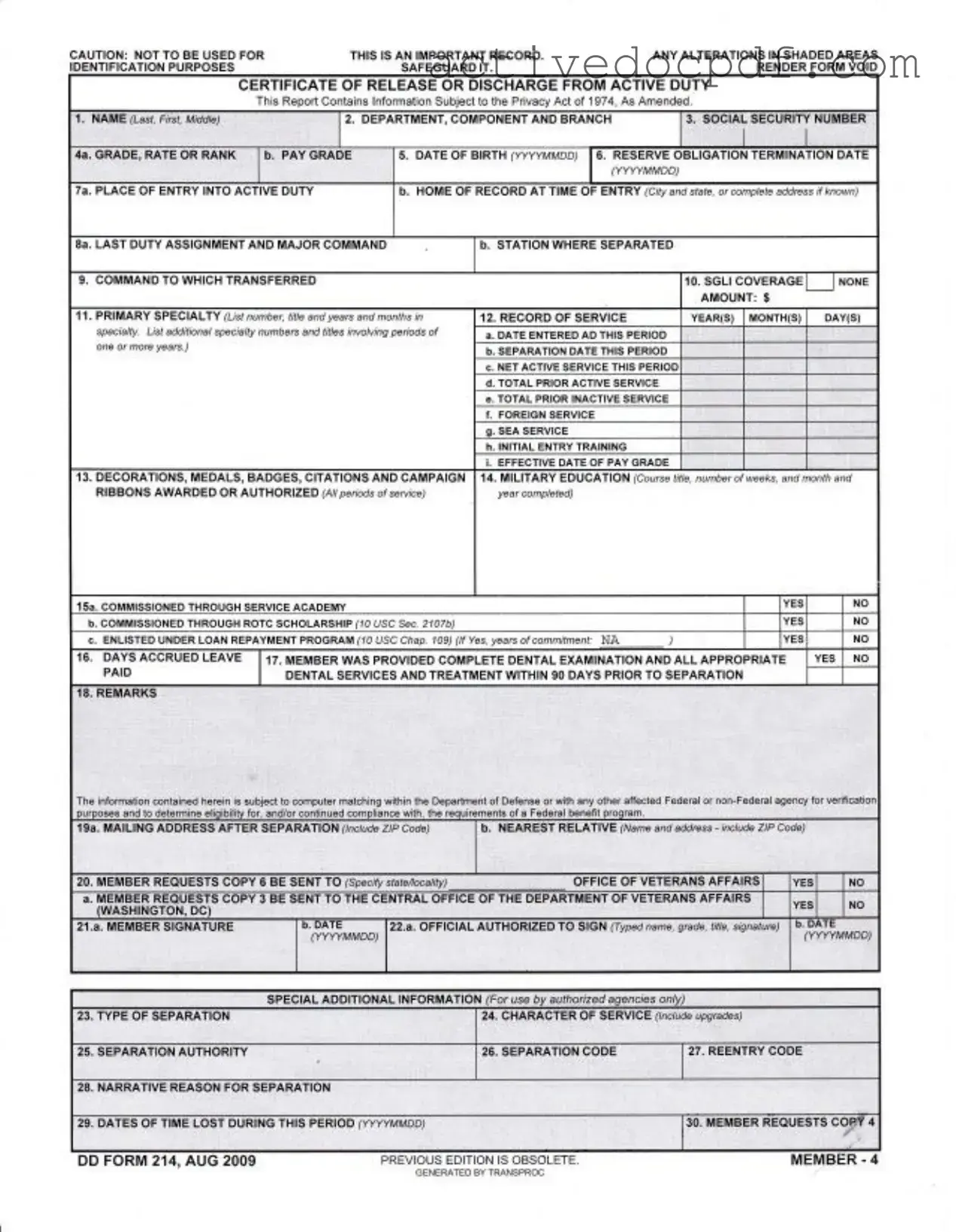
Free Dd 214 PDF Form
Misconceptions
The DD Form 214, officially known as the Certificate of Release or Discharge from Active Duty, is a crucial document for veterans. However, several misconceptions surround this form, leading to confusion among service members and their families. Here are six common misconceptions and clarifications for each:
- Misconception 1: The DD Form 214 is only necessary for veterans seeking benefits.
- Misconception 2: All DD Form 214s are the same.
- Misconception 3: The DD Form 214 can be used as a form of identification.
- Misconception 4: You can easily obtain a replacement DD Form 214 at any time.
- Misconception 5: The character of service on the DD Form 214 does not matter.
- Misconception 6: The DD Form 214 is only relevant immediately after separation.
While it is true that the DD Form 214 is essential for accessing veterans' benefits, it also serves other purposes. For instance, it is often required when applying for jobs, educational programs, or even certain licenses.
Not all DD Form 214s are identical. The form varies depending on the individual's service, such as the branch of military, type of discharge, and specific circumstances surrounding the separation. Each form contains unique information relevant to the service member's experience.
This is a significant misunderstanding. The DD Form 214 is not intended for identification purposes. It is a record of military service and should be safeguarded, as any alterations can render it void.
While it is possible to request a replacement, the process can take time. Veterans must submit a request through the National Archives or their respective military branch. It is advisable to keep the original safe to avoid delays.
The character of service is a critical component of the DD Form 214. It can impact eligibility for benefits and employment opportunities. Understanding the implications of the character of service is essential for veterans transitioning to civilian life.
Many individuals believe that the DD Form 214 loses its significance over time. However, it remains an important document throughout a veteran's life. It is often needed for various applications, including healthcare, education, and employment, long after leaving the service.
Documents used along the form
The DD Form 214 is a crucial document for veterans, serving as proof of military service and discharge status. However, there are several other forms and documents that often accompany it, each serving a unique purpose. Understanding these documents can help veterans navigate their benefits and entitlements more effectively.
- VA Form 21-526EZ: This is the application for disability compensation and related compensation benefits. Veterans use this form to apply for financial assistance due to service-related disabilities.
- Washington Non-disclosure Agreement Form: To protect sensitive information in your business dealings, consider the comprehensive Washington Non-disclosure Agreement for a legally binding arrangement.
- VA Form 22-1990: This form is used to apply for education benefits under the GI Bill. Veterans seeking to pursue further education or training will need to complete this form to access their benefits.
- VA Form 21-4142: This is the Authorization and Consent to Release Information to the Department of Veterans Affairs. Veterans use this form to allow the VA to obtain medical records or other necessary information from healthcare providers.
- VA Form 21-0781: This form is a Statement in Support of Claim for Service Connection for PTSD. Veterans who believe their PTSD is connected to their military service can use this form to provide supporting information for their claims.
- DD Form 215: This is a correction to the DD Form 214. If there are errors or omissions in the original DD 214, veterans can use this form to request corrections to their discharge records.
Each of these documents plays a vital role in ensuring that veterans receive the benefits and recognition they deserve. By familiarizing themselves with these forms, veterans can better advocate for their needs and navigate the complexities of the benefits system.
Check out Popular Documents
What Is a General Background Check - This form is essential for applicants seeking employment with Cracker Barrel Old Country Store.
In order to obtain compliance with the state's financial responsibility requirements, motorists must fill out the necessary documentation, as outlined by the state regulations. If you find yourself in need of the form to prove your insurance coverage, you can get it here to ensure you meet the requirements for lawful driving in Florida.
Acord 130 - The form collects the applicant's mailing address, including ZIP codes.
Key Details about Dd 214
What is a DD 214 form?
The DD 214, officially known as the Certificate of Release or Discharge from Active Duty, is a vital document for military service members. It provides a summary of a service member's time in the military, including their rank, duty assignments, and character of service. This form is essential for veterans seeking benefits, employment, or educational opportunities after their service.
Why is the DD 214 important?
The DD 214 serves multiple purposes. It acts as proof of military service, which is often required for accessing veterans' benefits, such as healthcare, education, and housing assistance. Additionally, employers may request this document to verify a candidate's military background. Safeguarding the DD 214 is crucial, as it contains sensitive personal information and details about service history.
How can I obtain my DD 214?
To obtain a copy of your DD 214, you can request it through the National Archives or the appropriate military branch. Here are the steps you can follow:
- Visit the National Archives website or the website of your military branch.
- Complete the request form, which may be available online or as a downloadable PDF.
- Provide any necessary identification and details about your service.
- Submit your request either electronically or by mail, depending on the instructions provided.
It may take some time to process your request, so plan accordingly.
What information is included on the DD 214?
The DD 214 contains various pieces of information, including:
- Your name and social security number
- Branch of service and component
- Rank and pay grade
- Dates of service and character of discharge
- Decorations and awards received
- Reason for separation
This information is crucial for understanding your military history and benefits eligibility.
What does the character of service mean?
The character of service is a designation that reflects the quality of a service member's time in the military. It can range from "Honorable" to "Other Than Honorable." An honorable discharge typically allows for access to a broader range of benefits, while a less favorable designation may limit eligibility. Understanding this designation is essential for navigating post-service opportunities.
Can I make changes to my DD 214?
Making changes to a DD 214 is not a simple process. If you find errors in your DD 214, you can request a correction through your military branch. This typically involves submitting a form, along with any supporting documentation that justifies the change. It’s important to act promptly, as alterations in certain areas can render the form void.
How does the DD 214 affect my benefits?
Your DD 214 is often a critical document for accessing veterans' benefits. Many programs require proof of service, and the details on your DD 214 will determine your eligibility for various benefits, including healthcare, education, and home loans. Ensuring that your DD 214 is accurate and up-to-date is essential for smooth access to these resources.
What should I do if I lose my DD 214?
If you lose your DD 214, don’t panic. You can request a replacement through the National Archives or your military branch. Follow the same steps as you would for obtaining your original DD 214. Having a copy of this document is crucial for future reference, especially when applying for benefits or employment.
Can family members access a deceased veteran's DD 214?
Yes, family members can request a deceased veteran's DD 214. They will need to provide proof of their relationship to the veteran, along with any necessary identification. This document can be essential for settling estates, accessing benefits, or honoring the veteran’s service.
Similar forms
- DD Form 215: This document is a correction to the DD 214. It provides updates or changes to the information originally recorded, ensuring that the veteran's record is accurate and up-to-date.
- DD Form 256: This form is a certificate of honorable discharge. It serves as proof that a service member has completed their service honorably, similar to how the DD 214 indicates the character of service.
- DD Form 257: This is a certificate of general discharge. It provides confirmation of a service member's discharge under honorable conditions, similar to the DD 214's purpose of documenting discharge status.
- Employment Verification form - Similar to the documents listed, this form is essential for validating a candidate's employment history, job title, and salary, and can be accessed through the Work Verification Letter.
- VA Form 21-526: This application for disability compensation is used by veterans to apply for benefits. Like the DD 214, it is essential for veterans seeking assistance from the Department of Veterans Affairs.
- VA Form 21-4138: This statement in support of claim allows veterans to provide additional information about their claims. It complements the DD 214 by offering context and details relevant to a veteran's service.
- SF-180: This form is used to request military records. It is similar to the DD 214 in that it helps veterans access their service information, which may be necessary for various benefits.
- Form DD 149: This form is used to apply for a correction of military records. Like the DD 214, it ensures that the veteran's service record is accurate and reflects their true service history.
Guide to Filling Out Dd 214
Filling out the DD Form 214 is an essential step for service members who are transitioning from active duty. This form serves as an official record of military service and is crucial for benefits and identification purposes. Follow these steps carefully to ensure that all information is accurately recorded.
- Obtain the form: You can access the DD Form 214 online or request a copy from your unit's administrative office.
- Fill in your name: Start by entering your last name, first name, and middle initial in the designated areas.
- Provide your Social Security number: Enter your Social Security number in the appropriate box.
- Indicate your rank: Fill in your grade, rate, or rank in section 4a, followed by your pay grade in section 4b.
- Enter your date of birth: Use the format YYYYMMDD to fill in your birth date.
- Reserve obligation termination date: Specify the date your reserve obligation ends.
- Place of entry: Indicate where you entered active duty.
- Last duty assignment: Fill in your last duty assignment and major command.
- Command to which transferred: If applicable, indicate the command to which you were transferred.
- Home of record: Provide your home of record at the time of entry.
- Military specialty: Fill in your military occupational specialty.
- List decorations: Document any awards, medals, badges, or campaign ribbons you received.
- Separation station: Indicate where you were separated from service.
- Accrued leave: Enter the number of days of accrued leave.
- Mailing address after separation: Provide your address where you want to receive correspondence.
- Signature: Sign and date the form in the designated areas.
- Request copies: Indicate if you want copies sent to the nearest office of Veterans Affairs and the central office in Washington, D.C.
Once you have completed the form, review it for any errors or omissions. It is important to ensure that all information is accurate before submission. After verification, submit the form to the appropriate military office for processing.